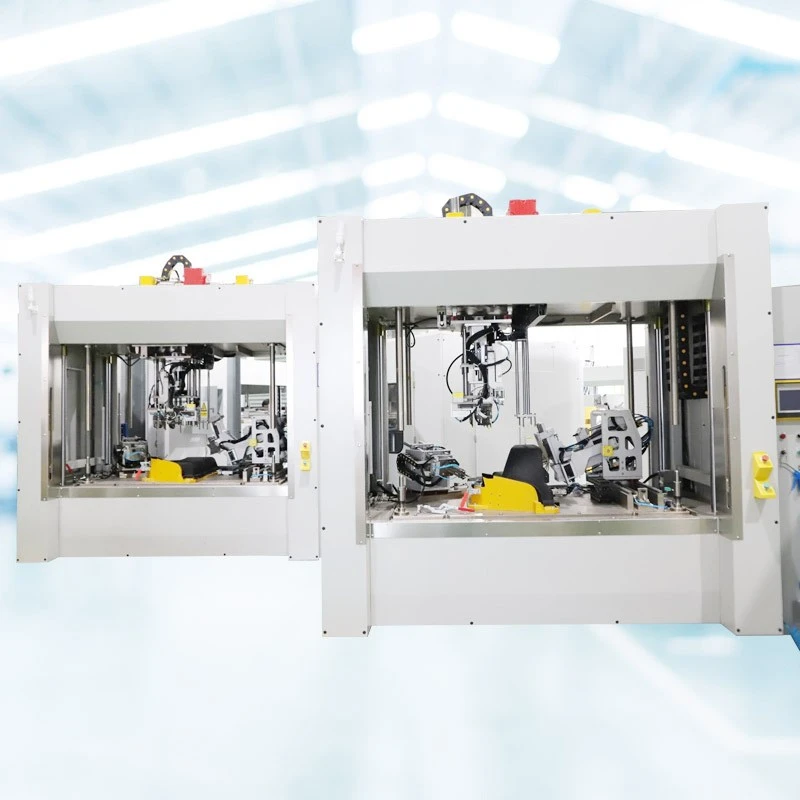


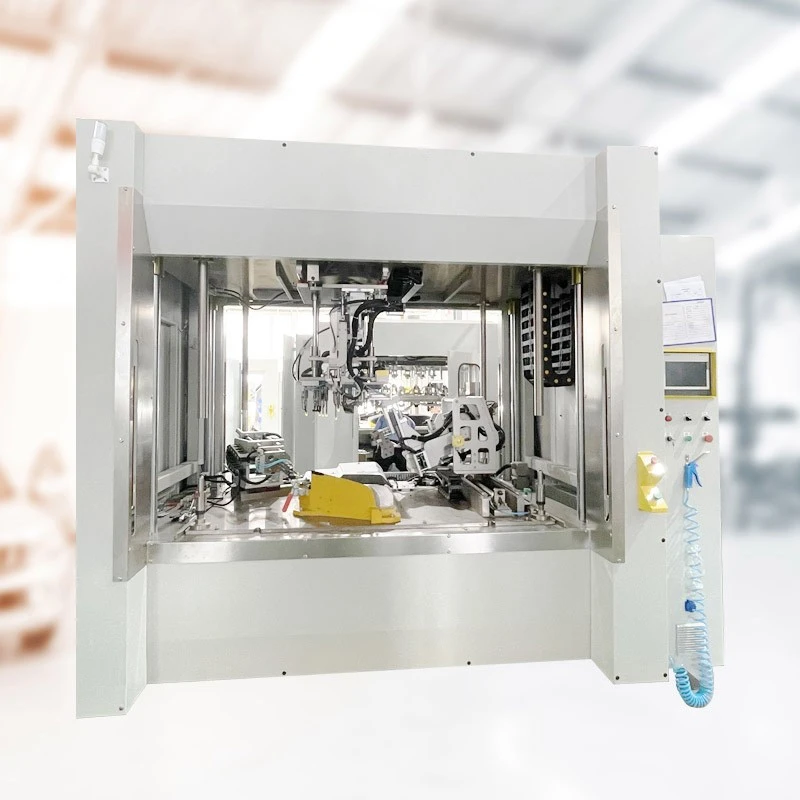
Heat Staking Welding Machine
Heat staking welding machine is a core thermal bonding technology for thermoplastic materials. It involves melting the connecting surfaces of components using a temperature-controlled heating plate at 230°C-400°C. Through a process of "fixing - melting - detaching - pressing -...
- Fast Delievery
- Quality Assurance
- 24/7 Customer Service
Product Introduction
Customized Automated Hot Riveting and Hot Plate Welding Equipment
• Cutting-edge Hybrid Welding Technology: Integrates hot plate welding and hot riveting processes, achieving seamless process switching. Equipped with high-precision servo technology (±0.1mm), effectively reducing total carbon emissions.
•Reliable Certification and Comprehensive Support: Heat staking welding machine Successfully passed CE certification, provides 10 years of full technical support, and has been validated in over 500 plastic production plants. The design complies with ISO 14001 environmental standards.
•Precision Engineering and Accurate Control: The welding unit is 360° flexibly adjustable, equipped with a buffer stop device, and the welding head angle achieves micron-level precision control (±0.05°). It adopts a dual-path pressure regulation design with real-time feedback.
•Intelligent Error Prevention: Equipped with workpiece detection sensors and a built-in advanced alarm system for part misalignment/missing parts, it performs comprehensive quality checks before welding operations.
•IoT-enabled Production: Enables real-time monitoring and adaptive control of the production process, features dual pressure control, adapts to diverse application scenarios, and has remote fault diagnosis capabilities.
•High-efficiency operation: The working area reaches 5000mm², supports continuous uninterrupted operation, and saves up to 20% energy compared to traditional welding systems.

What is a combined hot riveting and hot plate welding machine?
The organic integration of hot riveting and hot plate welding technologies in the Heat staking welding machine provides a comprehensive solution for automotive parts manufacturing. This system utilizes hot plate welding to create main structural connections with excellent sealing performance (compliant with IP67 standards); simultaneously, hot riveting, with its high precision of ±0.1 mm, accurately handles the connection needs of complex geometries and hard-to-reach areas. This integrated approach greatly enhances process flexibility, enabling efficient connection of similar and dissimilar materials in a single operation while retaining the unique advantages of both technologies.
This hybrid system boasts excellent material versatility: hot plate welding is optimized for thermoplastics (PP, ABS, PC, etc.), while hot riveting can simultaneously process plastics and metals (aluminum, steel). This dual capability facilitates the innovative development of metal-plastic hybrid components, expanding the design space for lightweight automotive structures. Advanced thermal control technology ensures energy efficiency, reducing energy consumption by 30% compared to traditional methods, while ensuring consistent joint quality throughout the entire production process.

From a production perspective, the combined solution of hot riveting and hot plate welding in the Heat staking welding machine offers significant advantages. The synchronous process reduces cycle time by 40% through parallel operation, and precise temperature control significantly reduces waste generation. The system incorporates IoT monitoring technology to track more than 15 quality parameters in real time, ensuring the reliability of mass production and meeting the automotive industry's IATF 16949 standard. Furthermore, its low-energy consumption and zero-VOC emission environmentally friendly operation aligns with the concept of sustainable manufacturing.
Get transparent pricing and customized production solutions
Each of our automated welding systems achieves a rapid return on investment through three core advantages: ✓ Precision engineering (±0.1mm repeatability ensures consistent weld quality across batches), ✓ Customized integration (tailor-made tooling, automation interfaces, and material-specific parameters), and ✓ On-demand performance (cycle time 80% faster than manual welding).
"24/7 technical support | Price matching guarantee | On-site installation | ISO 9001 certified"
Plastic Hot Riveting Technology in the Automotive Industry
Hot riveting (thermal riveting method) in the Heat staking welding machine has become a key plastic joining technology in modern automotive manufacturing, providing precise fastening for complex multi-material components. This process uses controllable heating elements to shape and reshape thermoplastic studs, pins, or bosses, forming permanent mechanical connections with clamping forces up to 500N. Hot riveting is particularly suitable for electronic housings, interior trim parts, and sensor mounts, with vibration-resistant connections capable of withstanding over 100,000 fatigue cycles (compliant with SAE J1488 standards) and maintaining consistent quality in mass production. This technology can join dissimilar materials (such as metal inserts and plastic substrates) and is an important component of lightweight automotive architecture.


To meet industry demands, automakers are gradually adopting advanced hot riveting systems equipped with servo-driven electric drives (repeatability ±0.02mm) and AI-powered thermal analysis capabilities. Modern applications include:
•Electric vehicle battery assemblies: using electrically insulated joints to secure busbars and thermal management components.
•Advanced Driver Assistance Systems (ADAS) sensor housings: maintaining micron-level alignment tolerances for radar/LiDAR modules.
•Intelligent Interior System: Touchscreen bezels and haptic feedback components can be secured without visible fasteners.
Thermal riveting technology offers numerous sustainability advantages, such as 40% energy savings compared to ultrasonic welding, and 100% recyclable joints, perfectly aligning with the automotive industry's circular economy goals. Furthermore, it integrates Industry 4.0 functionalities, including predictive maintenance algorithms and digital twin process optimization, further solidifying its position in next-generation automotive manufacturing.
Other Applications of Hot Riveting and Hot Plate Composite Welding
We provide professional hot melt plastic welding solutions for automotive parts, meeting various production requirements.
Medical Device Industry
These processes are widely used in medical device manufacturing to produce seals for surgical instruments, diagnostic devices, and implantable components, conforming to ISO 13485 standards. Particle-free operation ensures tissue biocompatibility, and precision connectors can withstand multiple sterilization cycles without performance degradation. This is crucial for Class II and Class III medical devices that come into direct contact with patients.
Consumer Electronics Industry
Consumer electronics manufacturers utilize hot riveting technology to create invisible connectors (tolerance ±0.05 mm) for smartphones and wearable devices, enabling slim designs. This technology eliminates visible screws in high-end devices while maintaining structural integrity after thousands of cycles, forming seamless connections that maintain a slim appearance and improve waterproofing.
Aerospace Industry
The aerospace industry applies these methods to interior panels and piping systems. The resulting connectors can withstand extreme temperatures (-55°C to 85°C) while maintaining structural integrity. These technologies not only reduce aircraft weight and meet aviation safety standards, but also create vibration-resistant connections capable of withstanding thousands of flight cycles.
New Energy and Home Appliance Industries: Thermal bonding technology benefits the energy and home appliance industries. In the electric vehicle sector, thermal riveting securely fastens battery components while providing electrical isolation. Hot plate welding creates airtight seals (pressure greater than 5 bar) for HVAC and filtration systems. These methods are increasingly used to connect renewable energy components, with UV-resistant connections lasting over 20 years.
Hot Tags: heat staking welding machine, China, suppliers, manufacturers, factory, customized, price, buy, made in China